

Arthritis is an inflammatory disease that affects one or more joints.
Joints are anatomical structures that connect two or more bones and are essential for the support and mobile function of the human skeleton.
There are many types (or forms) of arthritis. The causes that provoke its development can be traumatic, metabolic, infectious, autoimmune or idiopathic.
The best known and most common forms of arthritis are osteoarthritis and rheumatoid arthritis. However, we must not forget the existence of gout, psoriatic arthritis, ankylosing spondylitis, cervical spondylosis, systemic lupus erythematosus and enteropathic arthritis.
Arthritis is a long-standing (chronic) inflammatory disease characterized by joint pain and inflammation, with a significant impact on mobility and skeletal support. The most severe forms of arthritis can disfigure joints and affect the ability to carry out the simplest daily activities. If not recognized and treated, inflammation tends to
worsen over the years.
It is such a common disease that, according to statistical studies, in the UK alone around 10 million people in the UK suffer from arthritis out of a total population of around 64 million.
A similar statistical study involving the United States reported that the number of Americans with arthritis is approximately 52 million out of a total population of approximately 319 million.
About 1 in 6 people suffer from it and it affects all age groups, including children.
How a joint works
A joint can be a complex anatomical structure that connects two or more bones together.
There are about 360 of them in the human body and they are responsible for holding various bone segments together so that the skeleton can perform functions of support, mobility and protection.
Anatomists classify joints into three main categories.
A fibrous (or osteoarthritis) joint that is immobile and has bones connected by fibrous tissue. An example of this is the skull.
A cartilaginous (or osteoarthritis) joint with limited mobility, the bones of which are connected by cartilage. A classic example of hemiarthrosis is the vertebrae of the spine..
Synovial joints (or movable joints) are highly mobile due to their particular properties.
Elements such as: the articular surface (the part of the bone involved in arthritis), the joint capsule, the cavity
articular, the layer of hyaline cartilage that covers the joint surface, the synovium (or synovium) and many ligaments and tendons.
The most common osteoarthritis is the knee, shoulder or ankle joints.

What are the symptoms of arthritis?
Symptoms can occur intermittently throughout life, at varying degrees of intensity and remain silent even for many years.
Physical symptoms:
- Joint pain
- Stiffness of the joints
- Joint noises
- Deformity
- Tumefaction
- swelling
- Redness and heat
- Tiredness
- Temperature
Psychological and social symptoms:
- Anxiety
- Depression
- Feeling of helplessness and lack of autonomy
- Tendency to isolate
- Difficulties in the work or school environment
There are forms of arthritis that also affect non-articular anatomical areas such as skin layers, eyes, respiratory system and lymphatic system.
Diagnosis
To make a diagnosis, a doctor, usually a rheumatologist, first objectively evaluates the signs of the inflammatory process, namely swelling, redness, mobility, and body temperature, based on the patient’s medical history and clinical evaluation during a physical exam. Evaluate effectively.
In case of suspected arthritis, laboratory and instrumental tests will be performed as prescribed by the doctor:
- blood and urine tests
- Laboratory examination of synovial fluid
- X-ray
- MRI
- CT
- Arthroscopy (a test that can view the cartilage and ligaments in the joint)
If positive, these general tests are followed by more detailed tests aimed at identifying the exact type of arthritis, such as rheumatoid factor tests specific to rheumatoid arthritis. Depending on the case and the affected area, different specialists such as orthopedic surgeons, dermatologists and ophthalmologists can provide a more appropriate medical opinion for the disorder.

What are the causes?
The causes of arthritis can be traumatic, metabolic, infectious, autoimmune and idiopathic.
Various types of pre-existing arthropathies depend on the origin of the cause.
There are many types of arthritis, some more common than others.
The best known and most common forms of arthritis are undoubtedly the so-called arthritis and the so-called rheumatoid arthritis.
Among the rarer forms of arthritis deserve mention: ankylosing spondylitis, cervical spondylosis, fibromyalgia, systemic lupus erythematosus, gout, psoriatic arthritis, enteropathic arthritis, reactive arthritis, secondary arthritis, polymyalgia rheumatoid arthritis.
Juvenile forms of arthritis form a separate category. An inflammatory disease of the joints that mainly affects young people
Treatment for arthritis
To date, there is still no definitive cure for arthritis, except for arthritis of infectious origin, even if there are many pharmacological and non-pharmacological interventions that vary according to the species and allow the course to be maintained. There are effective treatment approaches for the disease.
An early and well-formulated diagnosis therefore allows a timely start of the disease management process, better outcomes and therefore a more favorable prognosis.
Overall, the goal of all of these intervention strategies is to reduce pain and increase mobility while improving the patient’s quality of life.
Several treatments or combinations of treatments are often needed to achieve a great effect. Among these, it is possible to include the use of specific food supplements in the diet. This is the case of our Artomove1, a food supplement based on vitamins and plant extracts that can contribute to the treatment of arthritis thanks to its effects on bone and joint structures.
In particular, it is an excellent adjuvant in osteo-articular problems characterized by cartilage alteration.
Rest alternating with adequate physical activity and correct nutrition is a useful therapeutic alternative and preventive measure applicable to all types of arthritis.
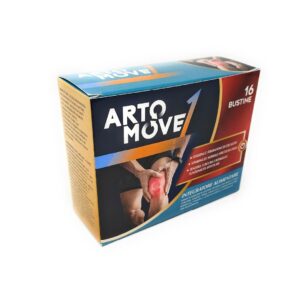
Artomove1
Food supplement based on vitamins, plant extracts and numerous other components indicated for its effects on bone and joint structures.